 Summarize this Article with AI
Key Highlights
- Glucoamylase (exo-1,4-glucosidase) is the rate-limiting enzyme converting dextrins and oligosaccharides to fermentable glucose in ethanol production.
- Optimal batch saccharification parameters: 55 to 60°C, pH 4.0 to 4.5, dosage 0.5 to 1.5 AGU/g starch.
- Thermostable glucoamylase variants extend activity to 60 to 65°C, enabling tighter SSF integration.
- Pullulanase co-dosing improves glucose yield by 2 to 4 percentage points by debranching alpha-1,6 linkages.
- Residual starch losses as small as 1% represent significant revenue loss at industrial scale.
- SSF, SHF, and SLSF each suit different plant configurations and raw material profiles.
- Corn, wheat, cassava, and sugarcane bagasse each require distinct enzyme strategies.
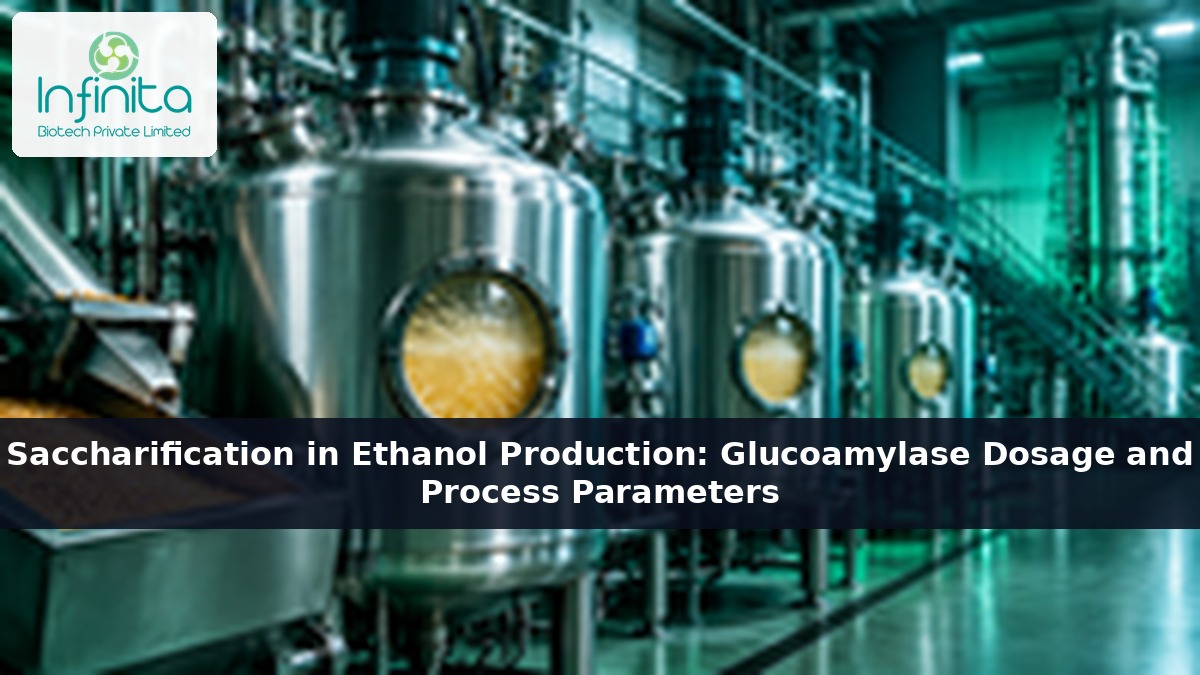
In any starch-based ethanol plant, the fermenters are only as productive as the saccharification step that feeds them. Alpha-amylase liquefies the gelatinized starch slurry into a mixture of dextrins, maltooligosaccharides, and some residual long-chain polymers. What yeast actually consumes is glucose, and that glucose must come from one enzyme: glucoamylase. Get the dosage, temperature, and pH right, and a modern distillery can convert more than 96% of available starch to fermentable sugar. Get it wrong, and every lost percentage point of glucose translates directly to lost liters of ethanol per tonne of grain.
This guide covers the complete saccharification optimization framework for industrial ethanol production, from glucoamylase biochemistry through process architecture choices and raw material-specific strategies. Whether you operate a 100 kL/day grain distillery or a 500 kL/day fuel ethanol plant evaluating SSF integration, the parameters discussed here apply directly to your operation.
1. What Is Saccharification and Why It Controls Ethanol Yield
Saccharification is the enzymatic conversion of liquefied starch into fermentable monosaccharides, primarily glucose. It is the second major enzymatic step in grain-to-ethanol production, following liquefaction (alpha-amylase action on gelatinized starch). The liquefied mash entering the saccharification vessel contains a complex mixture of linear dextrins (alpha-1,4 linked), branched dextrins (alpha-1,4 and alpha-1,6 linked), maltose, maltotriose, and small amounts of glucose. Yeast cannot directly ferment any substrate longer than a disaccharide with reasonable efficiency. Glucoamylase completes the breakdown.
The economic logic is straightforward. Corn starch contains approximately 70 to 72% fermentable carbohydrate by dry weight. Theoretical ethanol yield from glucose is 0.511 g ethanol per gram of glucose (Gay-Lussac equation). Industrial distilleries typically achieve 90 to 95% of theoretical yield, with saccharification efficiency being one of the largest controllable variables. At 10,000 tonnes of grain processed per month, moving from 92% to 95% saccharification efficiency adds thousands of additional liters of ethanol with zero additional raw material cost.
Process context: Saccharification does not begin in a vacuum. The quality of liquefaction (dextrose equivalent of the liquefied mash, residual intact starch granules, temperature history) directly determines how efficiently glucoamylase can act. A poorly liquefied mash with significant retrograded starch or ungelatinized granules will underperform regardless of glucoamylase dose.
The distillery enzyme range from Infinita Biotech includes both liquefaction and saccharification enzymes designed to work as a coordinated system, not as isolated additions.
2. Glucoamylase: Mechanism, Specificity, and Industrial Variants
Glucoamylase (also called amyloglucosidase, EC 3.2.1.3, exo-1,4-alpha-D-glucosidase) cleaves glucose units sequentially from the non-reducing ends of starch chains. It acts on both alpha-1,4 glycosidic bonds (the backbone of amylose and linear regions of amylopectin) and, at a significantly lower rate, on alpha-1,6 branch points. This dual specificity is what makes glucoamylase uniquely capable of fully hydrolyzing starch to glucose without requiring a separate debranching enzyme, though the low rate of alpha-1,6 cleavage makes pullulanase co-dosing advantageous in high-throughput settings.
2.1 Catalytic Architecture
The enzyme possesses a starch-binding domain (SBD) separate from its catalytic domain. The SBD adsorbs to starch granule surfaces, increasing local enzyme concentration and enabling raw starch hydrolysis in some variants. Industrial fermentation-derived glucoamylases from Aspergillus niger and engineered strains of Trichoderma reesei and Rhizopus oryzae are the most common sources. Each source organism imparts slightly different temperature optima and thermal stability profiles, which matters significantly when selecting an enzyme for SSF configurations.
2.2 Thermostable Variants
Standard A. niger glucoamylase denatures rapidly above 65°C. Thermostable variants, often produced from engineered strains or derived from thermophilic fungi, retain greater than 70% activity at 65°C for extended hold times. This is critical for simultaneous saccharification and fermentation (SSF), where the fermentation temperature (32 to 37°C for Saccharomyces cerevisiae) is far below optimal saccharification temperature, forcing a compromise. Thermostable glucoamylases allow saccharification pre-holds at higher temperatures before fermentation addition, reducing the compromise.
IUBMB classification for glucoamylase (exo-1,4-alpha-D-glucosidase), the primary saccharification enzyme in ethanol production
For plants evaluating second-generation biofuel enzyme systems, thermostable glucoamylase variants also appear in lignocellulosic ethanol contexts, though the substrate there shifts from starch to cellulose, requiring a different cellulase-centered enzyme cocktail.
3. Temperature Windows for Saccharification
Temperature is the most consequential single parameter in saccharification. It simultaneously determines enzyme activity rate, enzyme stability (and therefore useful lifetime in the vessel), and the thermodynamic favorability of the hydrolysis reaction.
3.1 Standard Batch Saccharification (55 to 60°C)
Conventional glucoamylase from Aspergillus niger achieves peak catalytic activity at 58 to 60°C. At this temperature, hydrolysis of a standard corn mash (30 to 35% dry solids) to greater than 95% glucose conversion requires 60 to 90 minutes at a dosage of 0.8 to 1.2 AGU/g starch. Below 55°C, the reaction rate slows substantially; below 50°C, enzymatic conversion of longer dextrins becomes the bottleneck, leaving significant fermentable sugar locked in oligosaccharides that yeast cannot access efficiently.
3.2 Thermostable Range (60 to 65°C)
Thermostable glucoamylase variants allow saccharification to run at 60 to 65°C without the rapid inactivation seen with standard enzymes. At 65°C, the increased reaction rate can reduce saccharification hold time to 45 to 60 minutes while maintaining greater than 96% conversion. This matters for throughput-constrained distilleries where saccharification vessel residence time is a bottleneck. The trade-off is typically higher enzyme cost per AGU unit, though operational savings from reduced hold time and improved yield can offset this.
3.3 SSF Temperature Compromise (32 to 37°C)
In true SSF configurations, saccharification and fermentation occur in the same vessel simultaneously. Yeast fermentation operates at 30 to 34°C for standard distiller’s yeast. Standard glucoamylase at 32°C retains only 20 to 30% of its peak activity. This is why SSF requires either significantly higher enzyme doses (1.5 to 3.0 AGU/g starch) or thermostable variants that maintain better activity at lower temperatures. Research published in Bioresource Technology has consistently shown that SSF ethanol yields can match or exceed SHF yields when enzyme selection accounts for the temperature compromise.
Temperature gradient caution: Cooling a hot (85 to 90°C post-liquefaction) mash rapidly to 60°C can cause starch retrogradation if cooling is uneven. Retrograded starch is significantly more resistant to enzymatic hydrolysis. Industrial heat exchangers should be calibrated to maintain uniform cooling without localized cold spots.
4. pH Optimization: Why 4.0 to 4.5 Is the Sweet Spot
Glucoamylase is an acid-active enzyme. Its activity-pH profile shows a broad optimum between pH 4.0 and 5.0, with a sharper peak at pH 4.2 to 4.5 for most industrial variants. The enzymatic mechanism involves two carboxylic acid residues in the active site, one acting as a proton donor and one as a nucleophile. Protonation state of these residues is pH-dependent, explaining why activity drops sharply below pH 3.5 and more gradually above pH 5.5.
4.1 Why Not Higher pH?
Operating saccharification above pH 5.0 creates two compounding problems. First, glucoamylase activity drops, extending hold time or reducing conversion. Second, higher pH favors Maillard reactions between reducing sugars and amino acids in the mash, consuming fermentable glucose as a by-product and generating brown pigments that can interfere with downstream processing. Maillard browning is essentially irreversible glucose loss.
4.2 Why Not Lower pH?
Operating below pH 3.8 reduces glucoamylase activity and can stress the yeast added in SSF configurations. Additionally, acid dosing costs increase at very low pH targets. pH 4.0 to 4.5 represents the practical balance between maximum enzyme activity, yeast compatibility, and acid consumption economics.
4.3 pH Drift During Saccharification
Saccharification itself generates organic acids (acetic acid from acetyl groups on arabinoxylans in wheat mash, for instance), and bacterial contamination can drop pH further via lactic acid production. pH monitoring during the saccharification hold is important in plants without sterile processing. A pH drift from 4.2 to 3.7 during a 90-minute hold can reduce glucose yield by 3 to 5 percentage points through combined effects of reduced enzyme activity and bacterial competition.
Target saccharification pH for maximum glucoamylase activity and minimum Maillard sugar loss in starch-based ethanol production
5. Glucoamylase Dosage Protocols: Finding the Economic Optimum
Glucoamylase activity is measured in AGU (amyloglucosidase units), where 1 AGU is defined as the amount of enzyme that hydrolyzes 1 micromole of maltose per minute under standard conditions (pH 4.3, 50°C). Industrial products are sold as concentrated liquids, typically 200 to 400 AGU/mL, and dosage is expressed as AGU per gram of starch on a dry basis (AGU/g DS).
5.1 Standard Dosage Ranges by Process Type
For batch saccharification (SHF), the working range is 0.5 to 1.5 AGU/g starch. Most optimized corn-mash operations target 0.8 to 1.0 AGU/g starch at 60°C, pH 4.2, achieving greater than 95% conversion in 60 to 90 minutes. Increasing dosage above 1.5 AGU/g starch produces diminishing returns in glucose yield. The enzyme becomes diffusion-limited rather than catalysis-limited at high concentrations relative to substrate, and transglycolysis (reverse reaction forming isomaltose from glucose) can actually increase at very high glucose and enzyme concentrations, slightly reducing net fermentable sugar.
5.2 SSF Dosage Adjustments
SSF configurations typically require 1.5 to 3.0 AGU/g starch to compensate for the lower operating temperature and the continuous glucose consumption by yeast that prevents product inhibition buildup. The economic calculation must weigh the increased enzyme cost against savings from eliminating a separate saccharification vessel and its associated cooling energy and residence time.
5.3 Dose Optimization Methodology
The industry-standard approach to dosage optimization is a glucose response curve: run a matrix of dosages (0.5, 0.75, 1.0, 1.25, 1.5 AGU/g DS) at fixed temperature and pH, and measure glucose at defined time points (30, 60, 90, 120 minutes). The knee of the curve, where additional enzyme generates less than 0.5 percentage points of additional glucose, defines the economic optimum. This experiment should be run with the actual mash from the specific raw material, as particle size, amylopectin content, and liquefaction DE all shift the curve.
Optimize Your Saccharification Yield
Infinita Biotech’s distillery enzyme range includes glucoamylase, thermostable variants for SSF, and pullulanase for debranching. Talk to our technical team for a dosage protocol tailored to your raw material and process configuration.
6. SSF vs SHF vs SLSF: Choosing the Right Process Architecture
Three main process architectures govern how saccharification integrates with the rest of ethanol production. Each presents distinct trade-offs in capital cost, enzyme efficiency, throughput, and final ethanol yield. Understanding these differences is prerequisite to choosing the right enzyme specification.
| Parameter | Batch SHF | SSF | SLSF |
|---|---|---|---|
| Saccharification temperature | 55 to 60°C | 32 to 37°C (compromised) | 60 to 65°C (pre-hold), then 32 to 37°C |
| Fermentation temperature | 30 to 34°C (separate vessel) | 30 to 34°C (same vessel) | 30 to 34°C (same vessel) |
| Glucoamylase dosage | 0.8 to 1.2 AGU/g DS | 1.5 to 3.0 AGU/g DS | 1.0 to 1.8 AGU/g DS |
| Pullulanase benefit | High | Moderate to high | High |
| End-product inhibition (glucose) | High (batch accumulation) | Low (continuous yeast consumption) | Low to moderate |
| Capital requirement | High (separate saccharification vessel) | Low (combined vessel) | Moderate (pre-hold stage added) |
| Sterility requirements | High for saccharification stage | Moderate (yeast present early) | Moderate |
| Typical ethanol yield vs theoretical | 90 to 95% | 88 to 95% | 91 to 96% |
| Best suited for | Grain distilleries, existing plants | New plants, lignocellulosic 2G | High-solids operations, cassava |
6.1 SHF (Separate Hydrolysis and Fermentation)
SHF is the established process in most grain-based distilleries globally. Liquefied mash is held at 55 to 60°C with glucoamylase and optionally pullulanase until greater than 95% glucose conversion is achieved, then cooled to fermentation temperature and pitched with yeast. The advantage is that each step runs at its optimal conditions. The disadvantage is the capital cost of dedicated saccharification vessels and the energy cost of cooling a large mash volume before fermentation. Glucose accumulation in the saccharification vessel can also cause some product inhibition of glucoamylase at high solids loadings.
6.2 SSF (Simultaneous Saccharification and Fermentation)
SSF eliminates the separate saccharification vessel by adding both enzyme and yeast to the liquefied mash simultaneously. Fermentation temperature (32 to 34°C) becomes the operating temperature for both processes. Glucoamylase activity at this temperature is 20 to 40% of its 60°C peak, so enzyme doses must increase proportionally. The key benefit is that yeast continuously consumes glucose as it is produced, preventing accumulation and thereby reducing end-product inhibition of glucoamylase. Research from the Technical University of Denmark and multiple Brazilian ethanol programs has demonstrated that optimized SSF can match SHF yields in corn and sugarcane contexts when enzyme selection accounts for the temperature compromise. Starch processing enzyme systems optimized for SSF require thermostable glucoamylase variants with high residual activity at 32 to 37°C.
6.3 SLSF (Simultaneous Liquefaction, Saccharification and Fermentation)
SLSF is the most integrated configuration, running liquefaction, saccharification, and fermentation in a single vessel. It requires specialized enzymes, typically a thermostable alpha-amylase and a thermostable glucoamylase, capable of functioning across the temperature gradient as the vessel cools from liquefaction temperature to fermentation temperature. SLSF reduces capital requirements most aggressively but demands more sophisticated enzyme management and tighter process control.
7. Pullulanase Synergy: Unlocking Alpha-1,6 Branch Points
Corn starch is approximately 25% amylose (essentially linear, alpha-1,4 linked) and 75% amylopectin (highly branched, with alpha-1,6 linkages at branch points approximately every 24 to 30 glucose units). When alpha-amylase liquefies this starch, it generates a mixture of linear and branched dextrins. Glucoamylase can cleave alpha-1,6 bonds but does so at approximately 30 to 50 times the rate of alpha-1,4 bond hydrolysis, meaning branch points are a kinetic bottleneck for complete glucose conversion.
Pullulanase (EC 3.2.1.41, pullulan-6-glucanohydrolase) specifically and rapidly cleaves alpha-1,6 linkages in pullulan, amylopectin, and branched dextrins. Co-dosing pullulanase with glucoamylase provides a synergistic effect: pullulanase debranches the oligosaccharide mixture, exposing additional linear chains that glucoamylase can rapidly process to glucose. The combined enzyme system consistently outperforms either enzyme alone by 2 to 4 percentage points in glucose yield from amylopectin-rich substrates.
Practical dosage guidance: A typical pullulanase co-dose for corn mash saccharification is 0.1 to 0.3 NPUN (neopullulanase unit equivalents) per gram of starch alongside glucoamylase at 0.8 to 1.0 AGU/g DS. The combined enzyme cost increase is usually offset by the yield improvement within 2 to 4 fermentation cycles. Industrial suppliers including Infinita Biotech offer pre-formulated glucoamylase plus pullulanase combinations calibrated for specific raw materials.
The starch processing enzyme range includes debranching enzyme options for both food-grade and distillery applications, though the dosing strategy differs between high-DE syrup production and ethanol fermentation.
8. Raw Material Considerations: Corn, Wheat, Cassava, and Bagasse
No single saccharification protocol fits all raw materials. Starch content, amylopectin-to-amylose ratio, gelatinization temperature, and non-starch polysaccharide composition vary enough between feedstocks to require distinct enzyme strategies.
8.1 Corn (Maize)
The dominant feedstock for fuel ethanol in the United States, corn contains 68 to 72% starch on a dry basis and gelatinizes at 62 to 72°C. Its high amylopectin content (approximately 75%) makes pullulanase co-dosing particularly valuable. Corn mash also contains non-starch polysaccharides including arabinoxylans and beta-glucans, which increase viscosity and can limit enzyme diffusion at high solid loadings. Hemicellulase addition (xylanase, beta-glucanase) is common practice in modern corn ethanol plants to manage viscosity and improve glucose release.
8.2 Wheat
Wheat starch (68 to 70% dry basis) has a bimodal granule distribution (A-granules and B-granules) that affects liquefaction kinetics. Beta-glucan content in wheat is significantly higher than in corn, often requiring dedicated beta-glucanase addition to manage viscosity. The arabinoxylans in wheat can also bind water and create gel-like structures that impede enzyme access to starch. Glucoamylase dosage for wheat mash is typically at the higher end of the range (1.0 to 1.5 AGU/g DS) to compensate for these diffusion barriers.
8.3 Cassava
Cassava root is widely used in Asian and African ethanol production. Its starch content can reach 25 to 35% fresh weight (65 to 70% dry basis). Cassava starch gelatinizes at a lower temperature (58 to 65°C) than corn or wheat, which can complicate the transition between liquefaction and saccharification temperatures. High cyanogenic glucoside content in raw cassava requires careful processing to avoid enzyme inhibition. SLSF configurations are particularly common with cassava, as the lower gelatinization temperature allows a more gradual temperature ramp-down through liquefaction, saccharification, and fermentation in a single vessel.
8.4 Sugarcane Bagasse (2G Ethanol)
Sugarcane bagasse is a lignocellulosic rather than starchy feedstock. The carbohydrate is locked in cellulose and hemicellulose, not starch. Saccharification of bagasse requires cellulases (endo-glucanase, cellobiohydrolase) and hemicellulases (xylanase, arabinofuranosidase) rather than alpha-amylase and glucoamylase. Beta-glucosidase plays the role analogous to glucoamylase, converting cellobiose (a cellulase end-product) to fermentable glucose. The second-generation biofuel enzyme systems are entirely distinct from first-generation grain ethanol enzymes and must be specified separately.
9. Residual Starch Losses and Their Economic Impact
Residual starch, starch that passes through saccharification unconverted to fermentable sugar, represents a direct and calculable revenue loss. Sources of residual starch include incomplete liquefaction before saccharification (undissolved granules resistant to glucoamylase), retrograded starch formed during cooling, insufficient glucoamylase dosage or contact time, pH drift outside the optimal window during saccharification, and mass-transfer limitations in poorly mixed fermenters.
In a 500-tonne-per-day grain distillery, 1% residual starch represents approximately 5 tonnes of unfermented starch daily, equivalent to several thousand liters of lost ethanol at standard yield factors.
Residual starch monitoring is typically performed by enzymatic assay on the fermented mash (stillage). The standard AOAC method 996.11 provides the reference procedure. Some distilleries run weekly residual starch checks as a process KPI. A rising trend in residual starch often precedes a yield drop by one to two fermentation cycles, making it a leading indicator of enzyme or process problems.
The most common causes of residual starch increases in otherwise stable operations are enzyme lot-to-lot variability (check AGU assay on incoming lots), pH meter calibration drift, liquefaction alpha-amylase underperformance (check DE of liquefied mash before saccharification addition), and contaminating microorganisms that compete for fermentable sugar. The quality and certification standards maintained by enzyme suppliers are relevant here because consistent enzyme activity across lots is prerequisite to stable process performance.
10. By-product Formation and Its Link to Saccharification Quality
Saccharification quality influences not just ethanol yield but also the formation of by-products that affect distillate quality and downstream processing costs.
10.1 Isomaltose and Reversion Products
At very high glucose concentrations and high glucoamylase concentrations, the enzyme can catalyze transglycosylation (reverse reaction), forming isomaltose and panose from glucose. These are non-fermentable by standard distillery yeast and represent lost glucose. This reversion is favored above approximately 30% glucose concentration and is more pronounced at higher enzyme doses. Maintaining glucose concentration below saturation by ensuring good mixing in the saccharification vessel mitigates this.
10.2 Glycerol Formation
Yeast produces glycerol as an osmoprotectant under high-osmolarity conditions (high sugar concentration at the start of fermentation). Poor saccharification that dumps a large glucose bolus at the beginning of fermentation can trigger glycerol overproduction, reducing ethanol yield by 0.5 to 1.5%. SSF mitigates this by releasing glucose gradually, maintaining lower osmolarity throughout fermentation.
10.3 Higher Alcohols and Fusel Oils
The amino acid metabolism of yeast during fermentation generates higher alcohols (propanol, isobutanol, amyl alcohols). While these are desired at low concentrations in spirits production for flavor, excessive fusel oil formation points to amino acid stress often linked to nitrogen imbalance in the mash. Saccharification temperature affects protein denaturation and amino acid release from the grain, indirectly influencing fusel oil formation.
10.4 Lactic Acid from Bacterial Contamination
Lactic acid bacteria (LAB) thrive in the pH 4.0 to 4.5 saccharification environment, particularly at temperatures below 55°C where their growth is not suppressed. LAB contamination during saccharification consumes glucose and generates lactic acid, reducing fermentable sugar and inhibiting yeast at high concentrations. Maintaining saccharification temperature at 60°C (above LAB growth optimum) for the full hold time is a primary contamination control measure in SHF configurations.
11. Who Uses Optimized Saccharification Protocols
Optimized glucoamylase saccharification protocols are relevant across a wide range of ethanol-producing industries. The specifics of dosage, temperature, and pH differ by application, but the underlying enzyme biology is consistent.
Fuel Ethanol Plants
Large-scale corn and wheat-based operations where enzyme efficiency at scale determines profitability. Saccharification optimization at this scale typically drives dedicated technical enzyme teams and ongoing process trials.
Grain Distilleries (Spirits)
Whiskey, vodka, and neutral spirit producers where both yield and distillate character matter. Saccharification enzyme selection influences congener profile alongside ethanol yield.
Craft Breweries and Distilleries
Smaller-scale operations benefit from tailored enzyme dosing that reduces cost per batch and improves consistency, particularly for adjunct-heavy mash bills.
2G Biofuel Producers
Lignocellulosic ethanol operations using bagasse, corn stover, or wheat straw require different saccharification enzyme systems (cellulase-centered) but benefit from the same optimization principles.
Cassava Ethanol Producers
South and Southeast Asian producers using cassava root need SLSF-compatible enzyme systems that handle the lower gelatinization temperature and high cyanide-removal requirements of cassava processing.
Industrial Glucose Producers
High-DE glucose syrup manufacturers use glucoamylase saccharification as their primary process step, requiring very high glucose purity and minimal reversion products.
12. Related Reading from Infinita Biotech
References and External Sources
- Olofsson, K., Bertilsson, M., & Liden, G. (2008). A short review on SSF: an interesting process option for ethanol production from lignocellulosic feedstocks. Biotechnology for Biofuels, 1(1), 7. doi:10.1186/1754-6834-1-7
- Nguyen, Q. D., Rezessy-Szabo, J. M., Claeyssens, M., Stals, I., & Hoschke, A. (2002). Purification and characterisation of amylolytic enzymes from thermophilic fungus Thermomyces lanuginosus. Enzyme and Microbial Technology, 31(3), 345-352.
- Mojovic, L., Nikolic, S., Rakin, M., & Vukasinovic, M. (2006). Production of bioethanol from corn meal hydrolyzates. Fuel, 85(12-13), 1750-1755.
- Srichuwong, S., Sunarti, T. C., Mishima, T., Isono, N., & Hisamatsu, M. (2005). Starches from different botanical sources I: Contribution of starch structure to swelling and pasting properties. Carbohydrate Polymers, 62(1), 25-34.
- Singh, V., & Eckhoff, S. R. (1996). Economics of germ preseparation for dry-grind ethanol facilities. Cereal Chemistry, 73(1), 39-41.
- Bothast, R. J., & Schlicher, M. A. (2005). Biotechnological processes for conversion of corn into ethanol. Applied Microbiology and Biotechnology, 67(1), 19-25.
Frequently Asked Questions
What is the optimal glucoamylase dosage for ethanol saccharification?
The standard dosage range for batch saccharification is 0.5 to 1.5 AGU per gram of starch (dry basis). Most corn-mash processes operate at 0.8 to 1.2 AGU/g starch, achieving greater than 95% starch conversion within 60 to 90 minutes at 60°C and pH 4.2. Exceeding 1.5 AGU/g starch rarely improves yield but increases enzyme cost and may promote maltose reversion at high glucose concentrations. Optimal dosage should be determined by running a glucose response curve against your specific mash and raw material.
What temperature is best for glucoamylase activity in saccharification?
Conventional glucoamylase variants peak at 55 to 60°C. Thermostable variants engineered for SSF (simultaneous saccharification and fermentation) remain meaningfully active at 60 to 65°C, allowing saccharification to run closer to liquefaction temperatures and reducing vessel hold time. At SSF operating temperatures (32 to 37°C), standard glucoamylase retains only 20 to 30% of peak activity, which is why thermostable variants or higher doses are recommended for SSF configurations.
What pH should saccharification run at for maximum glucose yield?
Glucoamylase achieves peak catalytic efficiency between pH 4.0 and 4.5. Operating outside this range, particularly above pH 5.0, reduces enzyme activity and increases the risk of Maillard reactions that consume fermentable sugars. Most distilleries set mash pH to 4.2 before the saccharification hold. pH should be monitored during the hold, as organic acid production or bacterial activity can cause drift that reduces conversion efficiency.
What is the difference between SSF and SHF in ethanol production?
SHF (separate hydrolysis and fermentation) runs saccharification first at 55 to 60°C, then cools the mash to 30 to 32°C for yeast fermentation in a separate vessel. SSF (simultaneous saccharification and fermentation) combines both steps at a compromised temperature around 32 to 37°C in one vessel, reducing capital cost and end-product inhibition but requiring higher enzyme doses or thermostable variants. SLSF adds liquefaction to the same vessel, further integrating operations but requiring the most sophisticated enzyme management.
Why is pullulanase used alongside glucoamylase in saccharification?
Glucoamylase is an exo-acting enzyme that cleaves alpha-1,4 linkages from the non-reducing ends of starch chains. It has limited efficiency on alpha-1,6 branch points found in amylopectin (approximately 75% of corn starch). Pullulanase specifically cleaves alpha-1,6 linkages, debranching the starch structure and exposing more alpha-1,4 chains for glucoamylase action. This synergy typically improves glucose yield by 2 to 4 percentage points on amylopectin-rich substrates like corn and wheat, with enzyme cost payback usually achieved within a few fermentation cycles.
Which raw materials require different glucoamylase strategies?
Corn and wheat starches have high amylopectin content (around 75%), making pullulanase co-dosing important. Both also contain non-starch polysaccharides that increase viscosity, often requiring hemicellulase (xylanase, beta-glucanase) additions. Cassava starch gelatinizes at lower temperatures (58 to 65°C), so dosage timing and vessel temperature management differ. Sugarcane bagasse (2G ethanol feedstock) is lignocellulosic rather than starchy, requiring cellulase-centered enzyme cocktails rather than glucoamylase as the primary saccharification enzyme.
What causes residual starch losses in saccharification?
Residual starch losses arise from insufficient enzyme dosage, suboptimal pH or temperature, incomplete liquefaction before saccharification (leaving intact granules resistant to glucoamylase), retrograded starch formed during uneven cooling, and inadequate mixing in large fermenters that creates enzyme-depleted zones. Monitoring residual starch in stillage using enzymatic assay (AOAC 996.11) is a standard KPI in professional distillery operations. Even 1% residual starch loss in a large grain distillery represents significant revenue loss per tonne of grain processed.
How does Infinita Biotech support distillery saccharification?
Infinita Biotech offers a dedicated distillery enzyme range including glucoamylase, thermostable variants for SSF integration, pullulanase for debranching, and alpha-amylase for liquefaction. The technical team provides dosage recommendations, process trials, and on-site support for both grain-based and 2G lignocellulosic ethanol operations. Infinita Biotech also supplies starch processing enzymes for glucose syrup and other starch conversion applications. Contact the team for a customized enzyme protocol based on your raw material, process configuration, and yield targets.