 Summarize this Article with AI
- Three distinct enzyme classes: Papain and bromelain are plant-derived cysteine proteases; subtilisin is a microbially produced serine protease with different substrate specificity and pH profile.
- Selective action on dead skin: All three enzymes cleave corneodesmosomal proteins in the stratum corneum without damaging the viable epidermis — unlike physical exfoliants.
- pH stability matters: Formulation pH directly determines enzyme activity — papain is optimal at pH 5.0–7.0; subtilisin at pH 7.5–9.5 for maximum performance.
- Bromelain has anti-inflammatory bonus: Bromelain inhibits prostaglandin synthesis, providing additional benefit for inflamed or reactive skin types.
- Subtilisin preferred for leave-on products: Its milder, more controlled keratolytic action and broad pH range make subtilisin the preferred enzyme for sensitive skin and daily-use formulations.
- Infinita Biotech supplies: Cosmetic-grade cosmetic enzymes including papain, bromelain, and protease for skincare formulation.
- What Is Enzymatic Exfoliation?
- Papain: Profile, Mechanism, and Skin Applications
- Bromelain: Profile, Anti-Inflammatory Activity, and Formulation
- Subtilisin: Industrial Serine Protease for Cosmetics
- Substrate Specificity and Corneodesmosome Targeting
- pH Stability and Formulation Windows
- Comparative Performance and Formulation Suitability
- Cosmetic Formulation Strategies
- Safety Profile and Regulatory Considerations
- Industries and Applications
- Related Reading
- Frequently Asked Questions
Exfoliation is one of the foundational steps in modern skincare — the controlled removal of dead corneocytes from the outermost layer of the skin (stratum corneum) to reveal smoother, more radiant skin and facilitate penetration of active ingredients. Physical exfoliants (scrubs, microbead replacements, abrasive pads) remove cells mechanically. Chemical exfoliants (alpha-hydroxy acids, beta-hydroxy acids) dissolve the desmosomes holding corneocytes together through acid-catalysed chemistry. Enzymatic exfoliation uses a third mechanism: targeted protease activity that selectively cleaves the protein bonds of corneodesmosomes.
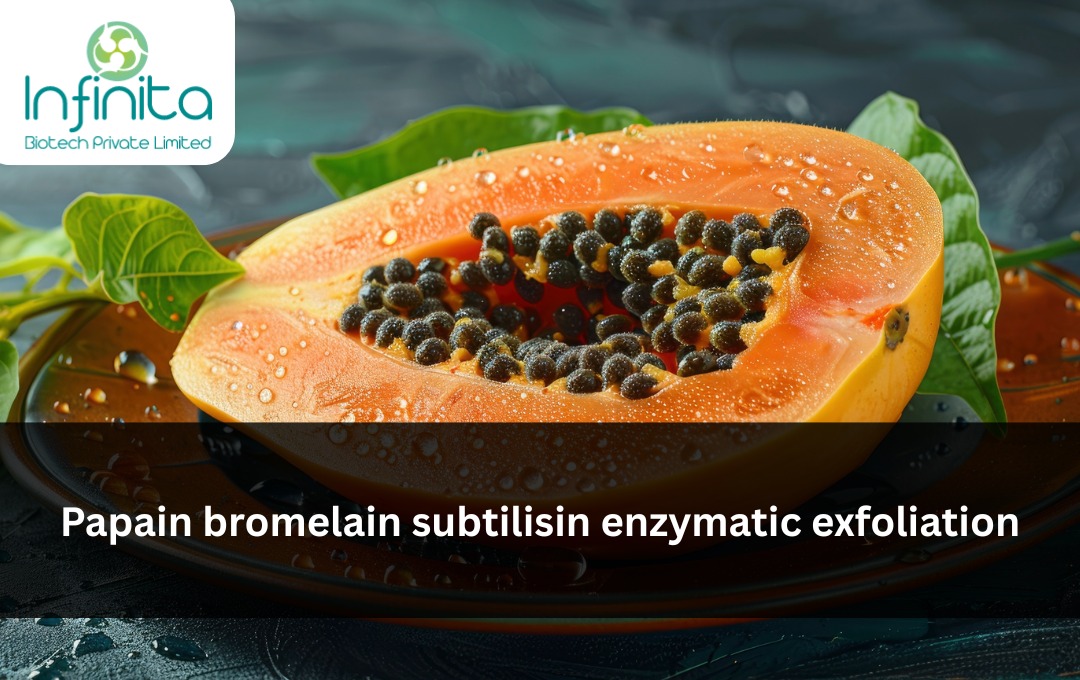
Three enzyme classes dominate commercial enzymatic exfoliation: papain from papaya, bromelain from pineapple, and subtilisin from Bacillus species. Each has distinct substrate specificity, pH stability, and formulation compatibility that determine when and how they are best deployed in cosmetic products. Infinita Biotech manufactures and supplies cosmetic-grade enzyme preparations including cosmetic enzymes for skincare formulation applications.
1. What Is Enzymatic Exfoliation?
The stratum corneum is the outermost layer of the epidermis, consisting of terminally differentiated corneocytes — flattened, enucleated cells filled with keratin filaments — held together by a lipid bilayer matrix and protein structures called corneodesmosomes. Natural skin renewal involves the gradual enzymatic degradation of corneodesmosomes by endogenous serine proteases (kallikreins), allowing controlled shedding of the outermost corneocyte layers. This process takes approximately 14–28 days in normal skin.
Topically applied exfoliant enzymes accelerate and augment this natural process by supplementing endogenous protease activity at the skin surface. Their action is selective because corneodesmosomal proteins — corneodesmosin, desmoglein-1, and desmocollin-1 — are exposed and accessible at the corneocyte junctions, while the proteins of living epidermal cells are protected by cell membranes and the controlled intra-cellular environment. The result is gentle, non-abrasive exfoliation that is suitable for skin types that cannot tolerate physical scrubbing or high-concentration AHA acids. The broader guide to enzymes in skincare covers the full scope of enzyme applications in modern cosmetics.
2. Papain: Profile, Mechanism, and Skin Applications
Enzyme Profile
Papain (EC 3.4.22.2) is a cysteine protease extracted from the latex of unripe papaya fruit (Carica papaya). It has a molecular weight of approximately 23,000 Da and contains the catalytic triad of cysteine, histidine, and asparagine characteristic of cysteine proteases. Activity is expressed in Tyrosine Units (TU) or NF Units per gram of preparation. Papain is commercially available in purified powder form and as standardised liquid preparations. Its stability in cosmetic formulations is moderate — it is sensitive to oxidation, heavy metal contamination, and temperatures above 60°C. Review the detailed papain enzyme profile for comprehensive technical data.
Skin Application Mechanism
In the stratum corneum, papain preferentially cleaves bonds adjacent to hydrophobic amino acids (phenylalanine, leucine, valine, tyrosine) — residues that are prevalent in the corneodesmosomal proteins desmoglein-1 and corneodesmosin. By hydrolysing these structural proteins, papain loosens the intercellular adhesion of corneocytes, enabling gentle shedding of the uppermost layers of the stratum corneum. Unlike AHAs, papain’s mechanism is purely proteolytic and does not depend on lowering skin surface pH.
Papain requires a reducing environment for full activity — the active site cysteine must be in the thiol (reduced) form. Cosmetic formulations containing papain should include reducing agents (glycerol, cysteine, or reducing peptides) and avoid oxidising preservatives (hydrogen peroxide, benzoyl peroxide) that would inactivate the enzyme.
3. Bromelain: Profile, Anti-Inflammatory Activity, and Formulation
Enzyme Profile
Bromelain is a collective term for a mixture of cysteine proteases isolated from pineapple (Ananas comosus) stem and fruit. Stem bromelain (EC 3.4.22.32) is the primary commercial form, with fruit bromelain (EC 3.4.22.33) used in some preparations. Molecular weight ranges from 28,000 to 33,000 Da depending on glycosylation state. Activity is expressed in Gelatin Digestion Units (GDU), Milk Clotting Units (MCU), or bromelain units (BU) per gram. The enzyme is stable across pH 5.0–8.5 and temperatures up to 60°C, making it more formulation-friendly than papain in near-neutral products. Full technical data on bromelain enzyme uses and benefits is available.
Anti-Inflammatory Mechanism
Beyond its keratolytic protease activity, bromelain exhibits documented anti-inflammatory properties through multiple mechanisms: inhibition of prostaglandin synthesis, modulation of cytokine signalling, and reduction in the expression of pro-inflammatory cell surface receptors. This dual action — exfoliation plus inflammation reduction — makes bromelain particularly valuable in formulations targeting acne-prone skin, post-treatment recovery care, and reactive skin conditions where conventional exfoliants cause irritation.
4. Subtilisin: Industrial Serine Protease for Cosmetics
Subtilisin (EC 3.4.21.62) is a serine endopeptidase produced by Bacillus subtilis and closely related Bacillus species. It is one of the most extensively characterised industrial enzymes, produced commercially at large scale primarily for the detergent industry and increasingly for cosmetic applications. Subtilisin has a molecular weight of approximately 27,000 Da and employs the classic serine protease catalytic triad of serine, histidine, and aspartate.
Its key cosmetic advantages over plant cysteine proteases are its broad pH activity range (5.5–11.0), high thermostability (active up to 70°C), excellent oxidative stability (unlike papain, it does not require a reducing environment), and its microbial origin allowing consistent, scalable production without crop dependency. Its substrate specificity — preferring aromatic (phenylalanine, tyrosine) and large aliphatic (leucine, methionine) residues at the P1 position — aligns well with corneodesmosomal protein structure. The broader class of proteolytic enzymes covers subtilisin’s classification within the serine protease family.
5. Substrate Specificity and Corneodesmosome Targeting
| Enzyme | Class | Preferred P1 Residues | Primary Corneodesmosomal Target | Selectivity for Stratum Corneum |
|---|---|---|---|---|
| Papain | Cysteine protease | Phe, Val, Leu, Tyr (hydrophobic) | Desmoglein-1, Corneodesmosin | High |
| Bromelain | Cysteine protease | Arg, Lys (basic); Phe, Leu | Desmoglein-1, Desmocollin-1 | High |
| Subtilisin | Serine protease | Phe, Tyr, Leu, Met | Corneodesmosin, Desmoglein-1 | Medium-High (broader substrate range) |
All three enzymes target the corneodesmosomal proteins of the stratum corneum, but their relative affinity for specific residue sequences differs. Papain and bromelain have narrower substrate specificity (predominantly hydrophobic residues for papain; basic plus hydrophobic for bromelain), which may explain their generally more selective action at the stratum corneum compared to subtilisin’s broader substrate range. However, at the concentrations and incubation times typical of cosmetic use (0.1–1.0% enzyme, 5–15 minutes contact time), all three enzymes exhibit practical selectivity for the accessible corneodesmosomal proteins over the protected cellular proteins of living skin.
6. pH Stability and Formulation Windows
| Enzyme | Active pH Range | Optimum pH | Recommended Formulation pH | Stability at Skin pH (5.5) |
|---|---|---|---|---|
| Papain | 3.5–8.0 | 5.0–7.0 | 4.5–6.5 | Good (active, ~60–80% max activity) |
| Bromelain | 5.0–8.5 | 6.0–7.5 | 5.0–7.5 | Good (active, ~70–85% max activity) |
| Subtilisin | 5.5–11.0 | 7.5–9.5 | 6.0–9.5 | Moderate (~40–60% max activity at pH 5.5) |
The pH of the cosmetic formulation has a direct and significant effect on enzyme activity delivered to skin. For papain and bromelain, the skin-compatible pH range of 4.5–6.5 aligns well with their activity optima, meaning that formulations targeting skin-compatible pH can deliver high enzyme activity. Subtilisin performs best at higher pH (7.5–9.5), which is less typical for skin-contact formulations. However, at formulation pH 6.0–7.5 (achievable in cleansers, body lotions, and some rinse-off products), subtilisin retains sufficient activity for effective exfoliation while providing its milder, more controlled keratolytic profile.
Source Cosmetic-Grade Enzymes From a Certified Manufacturer
Infinita Biotech supplies papain, bromelain, and protease preparations for cosmetic exfoliation formulations. Technical datasheets, activity declarations, and application support available.
7. Comparative Performance and Formulation Suitability
| Parameter | Papain | Bromelain | Subtilisin |
|---|---|---|---|
| Source | Papaya (plant) | Pineapple (plant) | Bacillus subtilis (microbial) |
| Keratolytic potency | High | Medium-High | Mild-Medium |
| Anti-inflammatory activity | None documented | Yes (prostaglandin inhibition) | None documented |
| Formulation stability | Moderate (redox sensitive) | Good | Very Good |
| Oxidative stability | Poor (inactivated by oxidants) | Moderate | Good |
| Best product type | Rinse-off enzyme masks, peels | Masks, toners, sensitive skin | Leave-on, daily use, baby care |
| Skin type suitability | Normal, oily, acne-prone | Sensitive, reactive, inflamed | All types including baby skin |
8. Cosmetic Formulation Strategies
Rinse-Off Enzyme Mask (Papain Primary)
A papain enzyme mask typically formulates papain at 0.2–0.8% by weight in a kaolin or bentonite clay base, adjusted to pH 5.0–6.0. The clay base absorbs excess sebum and provides the mechanical exfoliation complement to enzymatic action. Contact time of 5–15 minutes is standard. The reducing environment of the clay base should be verified — some clays contain oxidising trace metals that can inactivate papain. Enzymes in cosmetology cover the broader cosmetic chemistry context.
Gentle Daily Enzyme Cleanser (Subtilisin Primary)
Subtilisin at 0.05–0.2% in a sulphate-free surfactant base (pH 6.0–7.5) delivers mild daily exfoliation compatible with all skin types. The rinse-off format limits contact time and reduces the risk of over-exfoliation. This formulation approach is also used in enzymatic exfoliating body washes and enzymatic facial cleansers marketed for sensitive skin.
Combination AHA-Enzyme Peel Pad (Bromelain + Lactic Acid)
Formulating bromelain (0.1–0.3%) with lactic acid (5–10%) at pH 3.8–4.5 creates a dual-mechanism exfoliant: AHA activity loosens corneocyte adhesion through pH-dependent calcium chelation, while bromelain selectively cleaves corneodesmosomal proteins. The anti-inflammatory component of bromelain partially offsets any irritation from the lactic acid. This combination is particularly effective for photodamaged skin with abnormally thickened stratum corneum. For more on skin renewal enzymes, enzymes and skin renewal provides complementary reading.
9. Safety Profile and Regulatory Considerations
All three enzymes have well-established safety profiles in cosmetic use. Papain and bromelain are GRAS food ingredients with extensive safety history as processing aids. Subtilisin has an extensive detergent enzyme safety record and is included in the INCI (International Nomenclature of Cosmetic Ingredients) system as Subtilisin (INCI name). Key safety considerations include allergenic potential — particularly for subtilisin, which is a known occupational allergen in powdered form but is not allergenic at the concentrations used in finished cosmetic products — and the potential for over-exfoliation with concentrated preparations if used too frequently.
Concentration limits and usage guidelines for enzyme exfoliants in cosmetic products vary by regulatory jurisdiction. In the EU, the Cosmetics Regulation (EC 1223/2009) requires safety assessment by a qualified safety assessor for any novel ingredient or concentration. In India, the Bureau of Indian Standards (BIS) IS:4011 and IS:7890 standards govern cosmetic product safety requirements. Infinita Biotech certifications confirm compliance with applicable enzyme quality and safety standards.
10. Industries and Applications
- Skincare brands formulating cosmetic enzyme products
- Natural and organic skincare manufacturers
- Dermocosmetic brands developing enzyme peel formulations
- Professional skincare treatment product manufacturers
- Baby care product manufacturers using subtilisin
- Men’s grooming product brands incorporating enzymatic exfoliants
- Contract manufacturers producing private-label enzyme skincare
11. Related Reading
- Why Cosmetic Enzymes Are Key Functional Ingredients in Modern Skincare
- Bromelain Enzyme: Uses and Benefits
- What Is Papain Enzyme and How Is It Made?
- The Ultimate Guide to Enzymes in Skincare
- Enzymes and Skin Renewal: Essential Guide to Natural Beauty
- Biotechnology in Cosmetics: Enzymes Shaping Beauty’s Future
Key Takeaways
- Papain, bromelain, and subtilisin are three distinct enzyme classes with different substrate specificity, pH optima, and formulation stability profiles.
- All three selectively cleave corneodesmosomal proteins in the stratum corneum without damaging living epidermal cells — the defining advantage over physical exfoliants.
- Bromelain’s anti-inflammatory mechanism (prostaglandin inhibition) provides additional benefit for reactive and inflamed skin types beyond keratolytic exfoliation.
- Subtilisin’s broader pH range, oxidative stability, and milder action make it the preferred enzyme for leave-on products, daily-use formulations, and baby skincare.
- Formulation pH directly determines the enzyme activity delivered to skin — pH 5.0–6.5 is optimal for papain and bromelain; pH 6.0–8.0 for subtilisin in cosmetic applications.
- Enzyme exfoliants can be combined with AHAs and BHAs at appropriate pH for dual-mechanism formulations with enhanced exfoliation and anti-aging performance.
12. Frequently Asked Questions
What is enzymatic exfoliation and how does it differ from physical exfoliation?
Enzymatic exfoliation uses proteolytic enzymes to selectively hydrolyse the protein bonds holding dead corneocytes together in the stratum corneum. Unlike physical exfoliation, it requires no mechanical abrasion, making it suitable for sensitive, reactive, and rosacea-prone skin. The action is self-limiting at healthy skin depth.
How does papain exfoliate skin?
Papain is a cysteine protease that selectively degrades corneodesmosomal proteins (desmoglein-1, corneodesmosin) in the stratum corneum, enabling controlled shedding of dead corneocytes without damaging living epidermis. It preferentially cleaves bonds adjacent to hydrophobic amino acids. Full technical profile in our papain enzyme guide.
What is the difference between papain and bromelain in skincare?
Both are cysteine proteases but bromelain additionally exhibits anti-inflammatory activity through prostaglandin synthesis inhibition — a property papain does not share. Bromelain is better tolerated on inflamed or reactive skin types and has wider pH stability (5.0–8.5 vs papain’s 3.5–8.0).
What is subtilisin and why is it used in exfoliation formulations?
Subtilisin is a microbially produced serine protease with high thermostability, broad pH activity range (5.5–11.0), and excellent oxidative stability. In exfoliation formulations, it provides milder, more controlled keratolytic action than cysteine proteases, preferred for sensitive skin and daily-use products. Contact Infinita Biotech for subtilisin specifications.
What is the pH stability range of papain, bromelain, and subtilisin?
Papain: active pH 3.5–8.0, optimum 5.0–7.0. Bromelain: active pH 5.0–8.5, optimum 6.0–7.5. Subtilisin: active pH 5.5–11.0, optimum 7.5–9.5. For cosmetic leave-on formulations at skin-compatible pH (5.5–6.5), papain and bromelain retain highest activity while subtilisin operates at reduced but therapeutically sufficient levels.
Can protease enzymes be formulated into leave-on skincare products?
Yes. Leave-on formulations require lower enzyme activity levels and careful pH control. Subtilisin is preferred for leave-on applications due to its milder keratolytic profile. Rinse-off products offer greater flexibility in enzyme concentration and pH range for all three enzyme types.
How should enzyme exfoliants be combined with AHAs and BHAs?
Enzymatic and chemical exfoliants act through different mechanisms and can be combined. Keep formulation pH at 4.0–5.5 to maintain AHA/BHA activity while remaining within the active range of papain or bromelain. This creates a dual-mechanism product with enhanced exfoliation from complementary corneodesmosome disruption pathways.
What concentration of papain is used in an enzyme mask formulation?
Enzyme mask formulations typically contain papain at 0.1–1.0% by weight, with effective activity of 500–5,000 TU/g in the final product. Standardised papain preparations with declared activity units are preferred for reproducible performance. Dosage guidance is available from Infinita Biotech’s technical team.