 Summarize this Article with AI
- COD reduction of 50–70%: Enzyme consortia in aerobic biological treatment can bring food wastewater within CPCB discharge standards within 24–48 hours.
- Multi-enzyme activity: Effective consortia express protease, lipase, amylase, cellulase, and oxidoreductase activities collectively across the consortium members.
- Textile dye removal: Laccase and peroxidase-producing consortium members enable azo dye decolourisation alongside BOD/COD reduction.
- Self-sustaining catalysis: Microbial consortia produce enzymes continuously, supplementing or replacing the need for repeated free enzyme dosing.
- Establishment period: 7–21 days for consortium acclimation and population density establishment in new treatment systems.
- Infinita Biotech supplies: Industrial wastewater treatment enzymes and microbial preparations for food and textile effluent applications.
- What Are Microbial Enzyme Consortia?
- Mechanism: Enzymatic Pollutant Degradation
- Application in Food Industry Wastewater
- Application in Textile Industry Wastewater
- COD and BOD Reduction Data
- Consortium Design and Enzyme Composition
- Application and Dosing Protocols
- Compliance Standards and Regulatory Benchmarks
- Integration with Existing Treatment Systems
- Industries and Sectors
- Related Reading
- Frequently Asked Questions
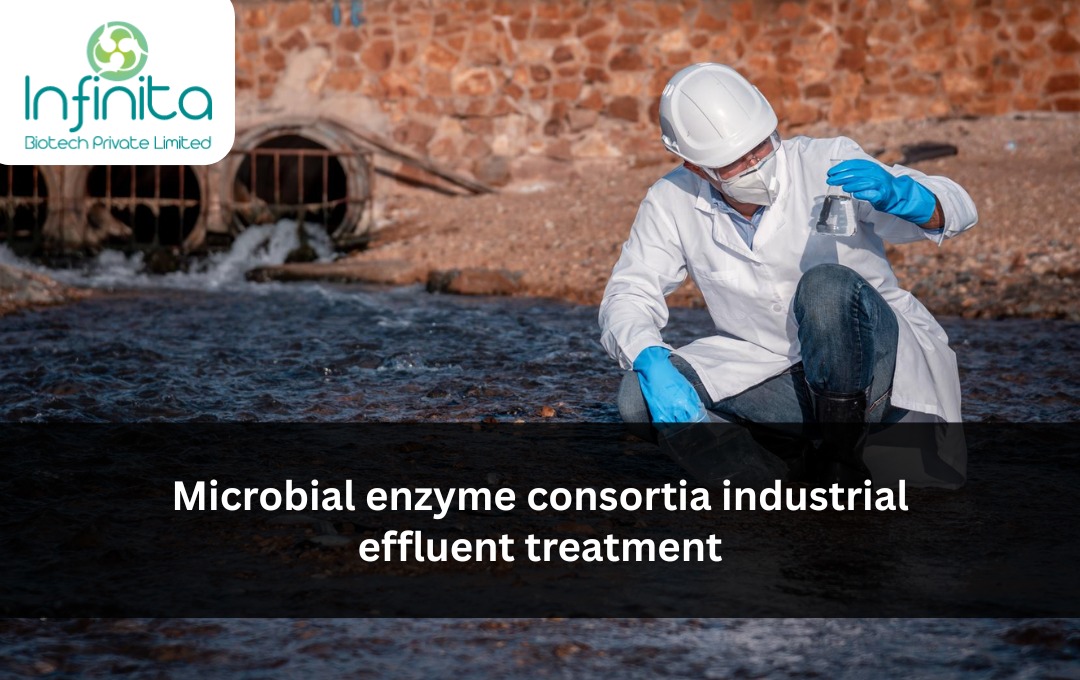
Industrial wastewater from food processing and textile manufacturing represents two of the most challenging effluent categories in terms of organic load, compositional complexity, and regulatory compliance. Food processing effluent contains high concentrations of proteins, fats, carbohydrates, and suspended solids. Textile wastewater carries dyes, surfactants, sizing agents, and the chemical residues of pre-treatment processes. Both streams must meet increasingly stringent discharge standards — and conventional treatment infrastructure is struggling to keep pace.
Microbial enzyme consortia represent a significant advance in biological treatment technology. By deploying designed combinations of microorganisms with complementary enzymatic capabilities, treatment plants can achieve faster hydrolysis, more complete mineralisation, and greater operational stability across variable influent compositions. Infinita Biotech manufactures wastewater treatment enzymes and biological preparations for food and textile effluent treatment systems.
1. What Are Microbial Enzyme Consortia?
A microbial enzyme consortium is a defined combination of microorganisms — bacteria, fungi, or both — selected and formulated for their collective enzymatic capabilities in degrading specific classes of industrial pollutants. The key principle distinguishing consortia from conventional activated sludge is intentionality: each member of the consortium is selected because it provides a specific enzyme activity or metabolic capability that complements the other members, creating a coordinated catalytic system.
Single-strain inoculants face limitations in industrial effluent treatment because real wastewater contains complex, heterogeneous organic matrices. A gram of food processing wastewater may contain dozens of protein types, multiple fat classes, various carbohydrate structures, and other organic compounds — no single organism produces all the enzymes needed to hydrolyse this matrix completely. A well-designed consortium distributes this metabolic burden across species with different enzyme repertoires.
The effectiveness of a microbial consortium in treating industrial effluent depends not just on the individual enzyme activities present but on the metabolic compatibility of consortium members — whether their activity profiles are cooperative (the products of one species are substrates for another) rather than competitive.
2. Mechanism: Enzymatic Pollutant Degradation
Hydrolysis Stage
The rate-limiting step in biological wastewater treatment is typically hydrolysis — the conversion of large, complex organic molecules into smaller, water-soluble fragments that microorganisms can transport across their cell membranes and metabolise. Hydrolytic enzymes secreted by consortium members — protease, lipase, amylase, cellulase, and pectinase — attack the external surface of suspended organic particles and dissolved macromolecules, generating monomers and oligomers as substrates for the consortium’s metabolic community.
Oxidation and Mineralisation
The hydrolysis products are subsequently oxidised through aerobic or anaerobic metabolic pathways by consortium members specialised in energy metabolism. Oxidoreductase enzymes including laccase, peroxidase, and various oxygenases contribute to the mineralisation of recalcitrant aromatic compounds — particularly important in textile wastewater containing synthetic dyes. The overall process converts complex organics to CO2, water, and inorganic salts, which is measured as the reduction in COD and BOD in the treated effluent. For additional detail on the role of enzymes in wastewater treatment, the biological principles are covered comprehensively.
3. Application in Food Industry Wastewater
Wastewater Characteristics
Food processing wastewater is characterised by high organic strength (COD 2,000–15,000 mg/L depending on the food category), high suspended solids (500–5,000 mg/L), variable pH, and fluctuating flow rates linked to production schedules. Dairy processing effluent contains lactose, casein, whey proteins, and milk fat. Meat processing effluent is rich in blood proteins, fat, and collagen. Starch and sugar processing effluent contains complex carbohydrates, fermentation by-products, and process chemicals. Each stream requires a tailored enzymatic response. Enzyme types for reducing BOD and COD vary by industry.
Enzyme Activities Required
Effective food wastewater consortia must collectively express protease for protein hydrolysis, lipase for fat and oil hydrolysis, amylase for starch breakdown, cellulase and pectinase for plant-derived fibre and pectin hydrolysis, and beta-glucosidase for hemicellulose-derived oligomers. The consortium is essentially a liquid enzyme factory deployed directly in the treatment system, producing these activities continuously as its members grow on the organic substrates present in the effluent.
Tackle Industrial Effluent With Proven Enzyme Technology
Infinita Biotech supplies wastewater treatment enzymes and microbial preparations for food and textile effluent treatment plants. Reach out for application support and compliance-focused dosing guidance.
4. Application in Textile Industry Wastewater
Specific Challenges
Textile wastewater presents additional complexity compared to food effluent: synthetic dyes (predominantly azo dyes), surfactants, sizing agents (starch, PVA), softening chemicals, and the residues of pre-treatment processes including NaOH and bleaching chemicals. The high colour load of textile effluent is visually and environmentally significant, and colour removal is often a separate compliance parameter from COD and BOD reduction.
Dye Decolourisation Mechanisms
Azo dyes — which comprise over 70% of commercial textile dyes — are cleaved at the azo bond (N=N) by azoreductase enzymes under anaerobic conditions, generating aromatic amines. Subsequent aerobic treatment mineralises these amines. Laccase, a copper-containing oxidoreductase produced by white-rot fungi, oxidises a wide range of aromatic dye compounds directly under aerobic conditions without requiring the anaerobic intermediate step. Textile wastewater consortia therefore often include fungi (such as Trametes species) alongside bacteria, to provide laccase and peroxidase activities that are beyond the typical bacterial enzyme repertoire.
5. COD and BOD Reduction Data
| Wastewater Type | Typical Influent COD (mg/L) | COD Reduction | Effluent COD (mg/L) | BOD Reduction |
|---|---|---|---|---|
| Dairy processing | 3,000–8,000 | 65–75% | 800–2,800 | 70–80% |
| Starch/sugar processing | 5,000–12,000 | 60–70% | 1,500–4,800 | 65–75% |
| Meat and poultry processing | 4,000–10,000 | 60–72% | 1,100–4,000 | 65–75% |
| Cotton textile (pre-treatment) | 2,000–6,000 | 55–65% | 700–2,700 | 60–70% |
| Textile (dye and finish) | 3,000–9,000 | 50–65% | 1,050–4,500 | 55–70% |
Note: These values represent performance achievable in optimised aerobic biological treatment using enzyme consortium augmentation. Final compliance with CPCB discharge norms (COD 250 mg/L, BOD 30 mg/L) typically requires a two-stage treatment sequence — primary physical-chemical treatment followed by biological treatment — with enzyme consortia deployed in the biological stage. Industrial wastewater treatment strategy design should account for influent variability in each specific facility.
6. Consortium Design and Enzyme Composition
Selection Principles
Effective consortium design follows several principles: metabolic complementarity (no two members competing for the same substrate without one’s product feeding another), environmental tolerance (all members must survive and function in the target effluent conditions), and stability (the consortium must resist displacement by native microorganisms in the treatment system over time). Commercially supplied consortia are validated for specific industry applications and should come with documented performance data for the target effluent category.
Core Enzyme Activities by Industry
For food wastewater: protease (serine, metalloprotease), lipase/esterase, alpha-amylase, glucoamylase, cellulase, pectinase. For textile wastewater: amylase (for starch sizing), laccase, azoreductase, peroxidase, pectinase (for bioscouring residue), protease. The combination of microbes and enzymes in bioremediation is a well-established field with growing industrial application.
7. Application and Dosing Protocols
Microbial consortia for industrial wastewater treatment are supplied as concentrated liquid preparations containing 10^8 to 10^10 viable cells per millilitre. Initial seeding doses for a new biological treatment system are typically 0.1–1.0% of treatment tank volume, applied over 3–5 days with monitoring of microbial population establishment. Maintenance dosing of 0.01–0.1% per day sustains the consortium population against natural die-off and effluent washout.
Free enzyme supplementation alongside microbial consortia — using formulated enzyme preparations — accelerates the hydrolysis stage in the first 7–14 days of operation and during periods of high organic loading shock. The synergy of pre-formulated enzyme dosing and microbial consortium activity is consistently more effective than either approach alone. Three key ways to use enzymes in wastewater treatment provide practical starting point guidance.
Critical dosing principle: Enzyme and consortium dosing should be matched to the organic loading rate — expressed as kg COD per day entering the biological treatment stage. Higher loading rates require proportionally higher enzyme and microbial inoculant doses to maintain the biological treatment kinetics needed for compliance.
8. Compliance Standards and Regulatory Benchmarks
In India, the Central Pollution Control Board (CPCB) sets General Effluent Discharge Standards applicable to all industries with COD at 250 mg/L maximum, BOD at 30 mg/L maximum, suspended solids at 100 mg/L maximum, and pH 5.5–9.0. Specific industries including textiles have additional colour and heavy metal limits. Meeting these standards from typical food and textile influent strengths requires achieving 92–98% COD reduction — which is only consistently achievable with a well-managed biological treatment stage incorporating effective microbial enzyme consortia.
The role of wastewater treatment enzymes in supporting regulatory compliance is becoming increasingly recognised by pollution control authorities, with enzyme-augmented biological treatment now accepted as a standard technology in environmental impact assessments for new food and textile processing facilities.
9. Integration with Existing Treatment Systems
Enzyme consortia integrate into existing treatment infrastructure without capital-intensive modifications. They are added to existing aeration tanks, equalization basins, or dedicated biological reactors. The most effective configurations include a primary screening and equalization stage for flow and load buffering, an enzyme-augmented aerobic biological treatment stage with consortium dosing, secondary clarification, and where required for colour, a tertiary polishing stage using activated carbon or electrocoagulation. Enzymes in sustainable wastewater treatment integrate with all these established treatment stages.
10. Industries and Sectors
- Food and beverage processors using wastewater treatment enzymes
- Dairy and milk processing plants
- Starch and sugar processing mills
- Meat and poultry processing facilities
- Textile wet processing and dyeing units
- Distillery and brewery effluent treatment plants
- Pharmaceutical manufacturing units
11. Related Reading
- Role of Enzymes in Wastewater Treatment
- Enzymes in Wastewater Treatment for Sustainable Removal
- Industrial Wastewater Treatment: Advanced Pollution Solution
- Different Types of Enzymes for Reducing BOD and COD Levels
- Role of Microbes and Enzymes in Bioremediation
- Top 3 Ways to Use Enzymes in Wastewater Treatment
Key Takeaways
- Microbial enzyme consortia combine multiple species with complementary enzyme activities for comprehensive industrial pollutant degradation.
- Food wastewater treatment requires protease, lipase, amylase, and cellulase activities; textile wastewater additionally requires laccase and azoreductase for dye removal.
- COD reductions of 50–75% are achievable in optimised aerobic biological treatment with consortium augmentation.
- The combination of free enzyme dosing and microbial consortium inoculation consistently outperforms either approach alone.
- Establishment periods of 7–21 days are required for new consortium deployments before full performance is achieved.
- Enzyme-augmented biological treatment is the most cost-effective route to meeting CPCB discharge standards from high-strength food and textile effluent.
12. Frequently Asked Questions
What are microbial enzyme consortia in wastewater treatment?
Microbial enzyme consortia are multi-species combinations of microorganisms selected for their collective enzymatic capabilities in degrading specific industrial pollutants. Unlike single-strain inoculants, consortia contain diverse enzyme activities enabling them to break down complex organic matrices in food and textile wastewater. See the full range of wastewater treatment enzymes from Infinita Biotech.
How much can enzyme consortia reduce COD in food wastewater?
In food processing wastewater, microbial enzyme consortia combined with enzyme dosing can reduce COD by 50–75% in aerobic biological treatment stages, often bringing influent COD of 3,000–12,000 mg/L significantly closer to CPCB discharge limits within a 24–48 hour treatment cycle.
Can enzyme consortia treat textile dye wastewater?
Yes. Textile dye wastewater requires laccase, peroxidase, and azoreductase activities for colour removal from azo dyes. A consortium combining laccase-producing fungi with hydrolase-producing bacteria achieves both colour removal and COD/BOD reduction in a single biological treatment stage.
How are microbial enzyme consortia applied in industrial treatment plants?
Consortia are applied as liquid inoculants to biological treatment stages. Initial seeding doses are 0.1–1.0% of tank volume, followed by maintenance dosing of 0.01–0.1% per day. Pre-formulated enzyme additions accelerate substrate hydrolysis during the establishment period and high-loading events.
What is the difference between enzyme dosing and microbial consortium dosing?
Free enzyme dosing provides immediate catalytic activity but enzymes are consumed over time. Microbial consortium dosing introduces living organisms that produce enzymes continuously. The most effective treatment combines both: free enzyme for rapid initial hydrolysis and microbial consortia for sustained continuous treatment.
Which enzymes are most important for food wastewater treatment?
Priority enzymes include protease (for protein-rich streams), lipase (for fat-rich streams), amylase (for starch-rich streams), and pectinase (for fruit and vegetable processing effluent). A consortium expressing all these activities is needed for comprehensive treatment. Contact Infinita Biotech for industry-specific recommendations.
How does temperature affect enzyme consortia performance?
Consortia are optimised for the mesophilic range of 25–40°C, which covers most tropical industrial effluent conditions in India. Effluent above 45°C may inhibit activity and require cooling or thermophilic consortium selection. pH optimum is typically 6.5–8.5 for most commercial consortia.
How long does it take to establish an effective enzyme consortium?
The establishment period for a new enzyme consortium in a biological treatment system is typically 7–21 days, during which the added populations acclimate to the effluent and achieve densities sufficient for measurable COD/BOD reduction. Commissioning support from the enzyme supplier is important during this period.