 Summarize this Article with AI
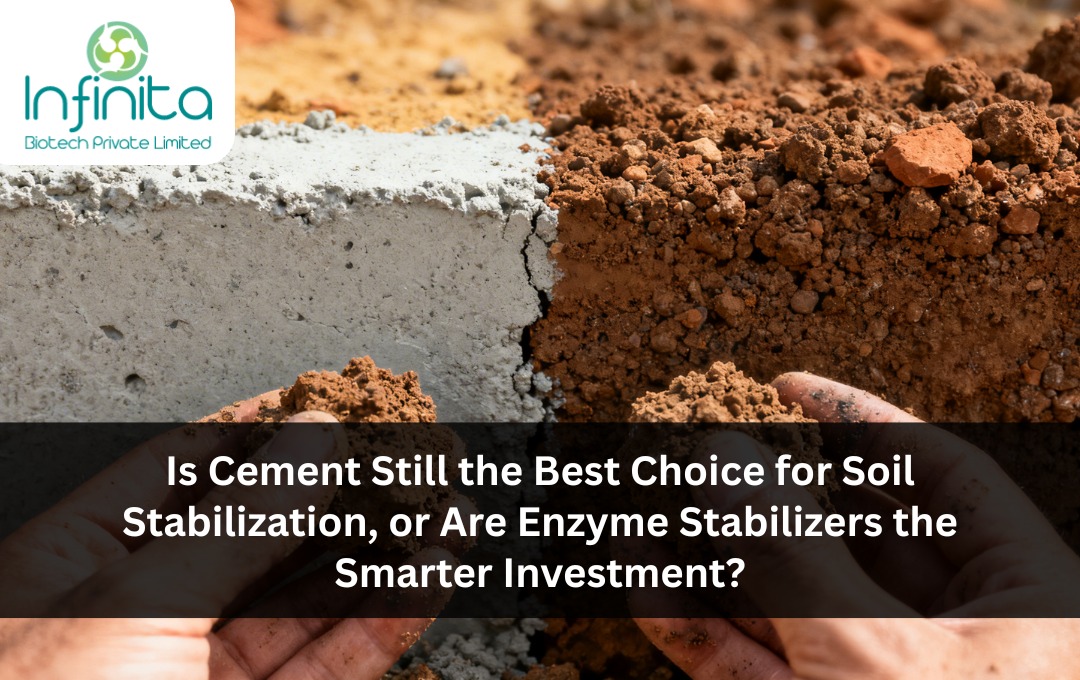
Stable ground is the backbone of every successful infrastructure project. From highways to rural roads, industrial yards to parking lots choosing the right soil stabilization method determines durability, lifecycle cost, and environmental impact. Traditionally, cement has been the go-to stabilizing agent. However, cement stabilization, although effective, comes with significant environmental concerns such as high CO₂ emissions, resource-intensive raw material extraction, and energy-intensive manufacturing processes that contribute heavily to the carbon footprint.
In contrast, enzyme-based soil stabilizers present a highly sustainable and forward-thinking alternative to conventional methods. They are characterized by a significantly lower carbon footprint, as their production and application do not rely on energy-intensive industrial processes. The absence of heavy manufacturing emissions, combined with minimal disturbance to the natural soil ecosystem during implementation, makes them environmentally responsible. Moreover, eco-friendly solutions like enzyme-based stabilizers are increasingly being adopted not only for their environmental benefits but also for their long-term cost efficiency. By reducing material consumption, transportation needs, and overall project expenses, they deliver both economic and sustainability advantages, making them a practical choice for modern infrastructure development.
In this blog, we’ll compare enzyme-based soil stabilizers vs cement stabilization, explaining their benefits, differences, application methods, and cost implications.
What Is Soil Stabilization?
Soil stabilization refers to a range of techniques used to improve the physical properties of soil. The goal is to enhance load-bearing capacity, reduce permeability, control moisture, and prevent erosion. Choosing the right stabilization method depends on soil type, project scale, environmental constraints, and budget.
Common Uses of Soil Stabilization
- Road and highway base strengthening
- Rural and unpaved road improvements
- Airport runways and airfields
- Industrial yards and parking areas
- Mining Haul Roads
Traditional Stabilization: Cement
Cement stabilization is one of the most widely used techniques worldwide. It involves mixing cement with soil to create a rigid, strong base. Cement reacts with soil and water through hydration, forming calcium silicate hydrates (C-S-H gel) that bind particles into a rigid mass. This increases compressive strength and stiffness of the road base.
Limitations of Cement Stabilization
- High Carbon Footprint: Cement production emits significant CO₂ — approximately 0.8 tons of CO₂ per ton of cement produced.
- Higher Costs in Some Regions: Cement costs can be volatile depending on supply and transportation.
- Longer Construction Time: Needs longer curing time.
- Required in Bulk Quantity: Cement stabilization typically requires 5–12% of dry soil weight depending on the soil type, which translates to 80–200 kg of cement per m³ of soil.
- Brittleness: Cement-treated soil can crack under extreme stress or cyclic loads.
- Not Always Ideal for All Soil Types: Very clayey soils may show lower performance without special treatment.
Modern Alternative: Enzyme-Based Soil Stabilizers
Enzyme-based soil stabilizers are bio-chemical solutions developed to improve soil properties naturally without adding bulky binders like cement.
How Enzyme Stabilizers Work
Enzyme stabilizers are organic or bio-based solutions that react with soil particles and moisture. They accelerate the natural soil particle rearrangement and binding process by reducing plasticity and increasing particle adhesion. Learn more about how enzymes are used in soil stabilization during road construction.
Key Mechanisms
- Enhances soil particle bonding
- Reduces free water mobility in soil
- Improves compaction efficiency
- Limits future moisture fluctuations
Benefits of Enzyme-Based Stabilization
- Eco-Friendly: They have minimal environmental impact and low carbon footprint.
- Rapid Implementation: No long curing periods; construction can proceed quickly.
- Effective in Moisture Control: Reduces swelling and shrinkage by binding soil moisture.
- Cost-Effective: Often requires less material and labor compared to cement.
- Improves Workability: Treated soil becomes easier to compact.
Conclusion
The strength of every great road lies in the soil beneath it. For decades, engineers have sought ways to make weak soils stronger, more stable, and more resilient. Today, with biotechnology and innovation, that goal has been achieved.
As the global infrastructure expands, the need for eco-friendly and economical road-building solutions will continue to rise, thus enzyme-based soil stabilization is not just a substitute for cement — it is a revolutionary step forward in sustainable construction practices. Explore our range of bio-enzymes for soil stabilization to find the right solution for your project.